Traversal and Movement
From point A to point ?

I remember a game called Galleon. I remember watching game-play footage videos and one thing stuck out to me - the movement. The main character, a rapscallion named Rhama, would hurl himself off ledges, land running, and sprint across a long field only to dash up the side of a cliff face. Watching the avatar fly so freely around the map was genuinely what I’d always wanted to do in a video game. It looked liberating in a way that only a video game can be.
Good video game design does that, it opens up your mind to the idea that just beyond the next ridge line, something awaits. It’s not only the destination we are looking forward to, it’s the transitionary space in-between that is just as exciting. Traversal in video games is often intertwined with the mechanics where we spend most of our time, and one that is very tricky to make less frustrating and more engaging.
Video games are actions in motion. Unlike a board game which is largely static or reactive in state, a typical video game deals with time and space. Things are updating in this space on a loop. We are dealing with events, physics and interactivity. This idea of movement and arrival through interaction in video games separates it from every other digital medium. Interactivity is the abstraction that occurs between an input and an output.
Expression
It begins with exploration and curiosity. In a 2D-platformer, what happens when you press right on the d-pad? You move right on the screen and the screen scrolls to unveil the next portion of the level map. What is the nuance to the movement? How is it expressed? In a typical 2D game, this is a digital input - on or off; only two states - yet Super Mario Bros. captures inertia, weight and speed through this simple binary mechanism. Nintendo are masters of understanding the abstraction layer between control, input and output. The combination of these elements result in satisfying interactivity.
Other input methods offer different experiences and often more granularity. The analog stick gives an array of numbers along an axis. Now instead of binary input we have a wide array to control to how fast or slow we might move around. And by that extension, the analog stick opens up entirely new ideas in how we might be able to express different types of movements. In a 3D Mario game, you can perform a hard “pivot” from up to down or vice-versa of the stick, combined with jump will launch Mario in the air for a backwards somersault that has a tactility that feels satisfying.
Flavors of Movement
The cape in Super Mario World gives a sense of freedom to fly up and then glide through the level. It tears down the players pre-conceived notions of the rules that govern the game. Alternatively, some games move in the other direction, instead of giving us a set of impossible movements - we are instead given a movement system closer to our own natural human limitations.
ICO (Fumitu Ueda) is a game that creates physical movements that aren’t based in superhuman abilities, but rather clumsy because of our human limitations. When you move the characters body around it has a sense of weight that feels like you are fighting gravity with the weight of your body. Once Yorda is introduced as a character you must guide and protect her by grabbing her hand, the act of “pulling” and shifting her weight with you feels equally grounded. Slower, deliberate animations to climb and swing over obstacles give the game a sense of reality juxtaposed in a world that looks ancient and mythical. These physics against this surreal landscape of ICO feels akin to a half-remembered dream. In this way, traversal not only impacts gameplay, it also directly impacts mood and theme.
On the extreme scale of traversal, what if we instead try to model the muscular skeletal system in it’s most literal sense? Getting over it with bennet Foddy, QWOP - games that intentionally handicap your expectations of movement in order for you to find liberation in “re-learning how to walk”. This game design anchors around the traversal as skill expression.
The Traversal Puzzle
Tears of the Kingdom and Breath of the Wild have looked at traversal as a problem and built as many as tools as possible to get around it in a compelling way. The entire ethos of the design hinges around “how can we break the players assumptions for how they move through a 3D environment?”. The glider is an early item in both of these games. The idea is to compel you to climb and climbing just about any surface is a key feature. If you wanna have fun with the glider you will climb to the highest point to do so. In Tears of the Kingdom, Nintendo pushes this idea into more abstract thought, what about a tool to quite literally move through a ceiling to the next floor surface? It incentivizes the player to care about the geo-spatial part of the game. Caring about the verticality of the terrain. Most games are content to give you a mini-map which draws your focus away from the 3D environment in front of you - these Zelda games make paying attention to the environment compelling.
Pseudoregalia, an indie action adventure game, does a thing where it challenges you to do something that looks impossible at the outset until you realize it might just be barely possible until eventually you obtain mastery over its mechanics that it becomes muscle memory. You will look at the geometry and think, “could this really be what I have to do?” and it almost always IS what you have to do. It can feel extreme at times, but the games toolkit for movement is so concise and fun to play with that you never feel frustrated by the game, you feel frustrated with yourself.
Liminal Space Design
Most modern games use traversal as a means to an end. Where are we going? Why are we going there? What’s in it for me. The carrot on the stick is almost always some sort of distinct reward. Loot, achievements, experience points. There needs to be something that can be indexed on the ledger to your account. Something tangible you can reflect on and see in the future. That is the reason we are going to move anywhere through the space, right? While this is typically true new games appealing to younger audiences are using a different approach.
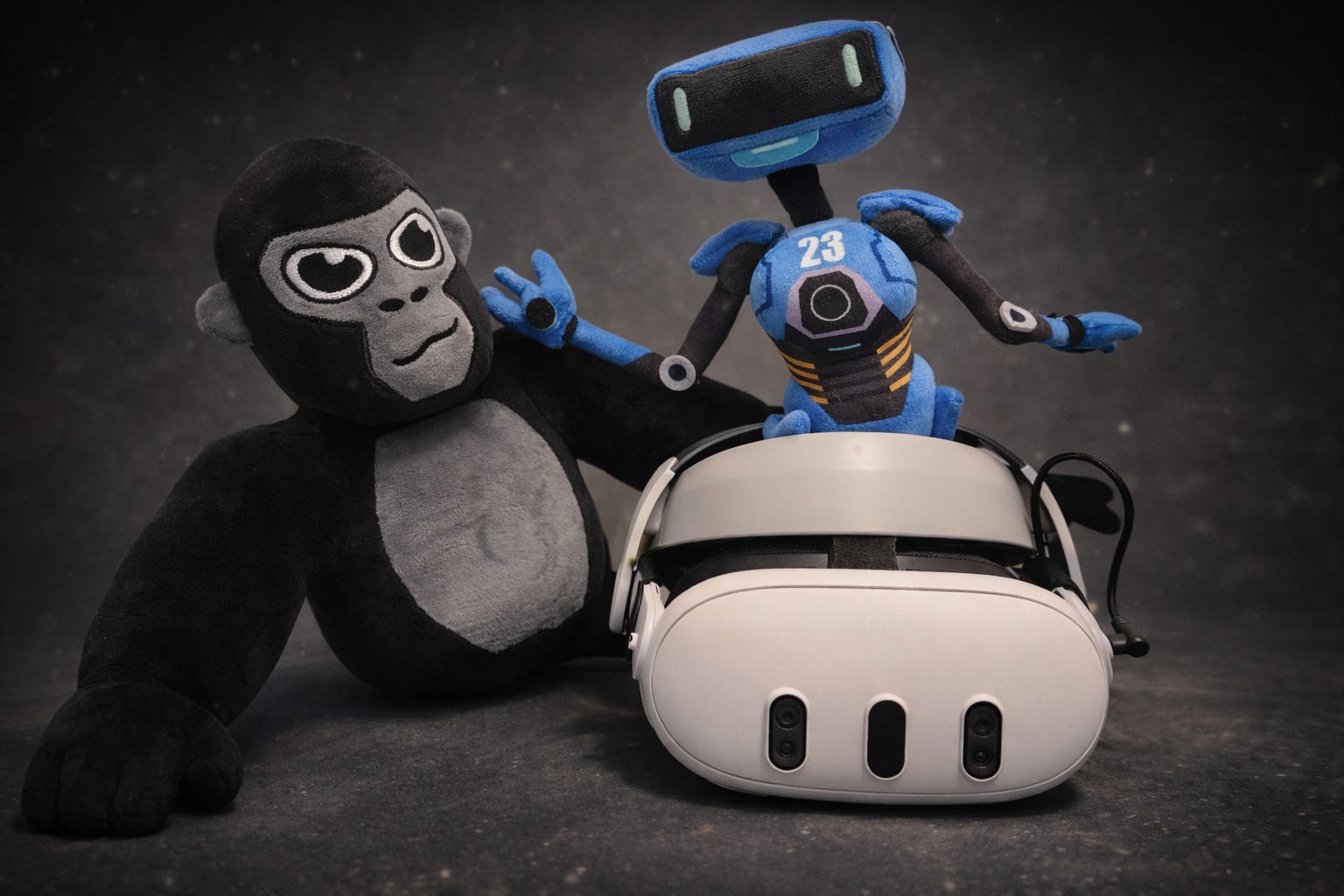
In Gorilla Tag, the transitional space itself is the forefront of the reward. Gorilla Tags approach to design only works because of it’s social and movement mechanisms. The joy of discovery in Gorilla Tag in large part works because the nature of it’s movement feels so satisfying. You might think of a game like Minecraft, that doesn’t present a direct objective - however, we are still ultimately moving towards a space because it’s likely that space has the resources we need to continue our progression to craft something.
The difference I see in Gorilla Tag is that focusing on traversal as the overarching experience means we return back to game design that focuses on a sense of play. There’s a reason I love to reference Nintendo games, Nintendo is a AAA games company that adheres to this design philosophy. A sense of wonderment that comes from experimentation through discovery. By not adhering to hard line rules or paths to “success”, but rather asking the player to interact with the world and see what happens. Gorilla Tag I think is the evolution of this design. It combines interactivity with a large open-ended space that feels liminal, only until you mesh the social aspect on-top of it. Now it becomes a playground. A virtual playground with no inherent objective or goal other than to move through and imagine with the people around you.
There’s something we’ve lost touch with as adults. We’ve forgotten how to go up to people on the playground and ask if someone wants to play. When you go to a park as a kid, you just interact with other kids. You ask them questions. There’s this spirit of play and discovery, and by not having these tutorials and mandatory steps in the game, we’re steering people toward the joy of exploration and discovery. It not only makes you want to explore, it encourages you to be social.
- David Yee, Another Axiom
Learning All Over Again
For a long time I didn’t even Gorilla Tag, I viewed it I think how most people in my age demographic do, a simple game designed to distract children. Setting aside my biases, I decided to give Gorilla Tag an honest effort. I wanted to see why this was one the most popular VR games. At first, it felt clunky, it felt janky and it made me feel clumsy and disoriented. I did this for a while and ultimately the loud screaming children and “pointless” nature of the game made me fall off of it. Months later I heard rumblings for Orion Drift, a game co-created by people behind Gorilla Tag and Echo Arena and it caught my interest. Eventually, when the game released I dove into it and was having the same experiences I did in Gorilla Tag. This time however I persisted. And then I persisted more. And then more. Things started to change with the way I was grappling with the mechanics and my ease of comfort with the game itself. Eventually, about 8 hours in, something clicked for me. I began to understand why this game, Gorilla Tag and all of it’s clones work. I had the revelation that my biases were anchored on so many previous experiences I had in VR and my 25+ years of playing flatscreen video games.
I began to understand that there was a whole generation of gamers playing these games with a level of familiarity and natural understanding of these mechanics. These gamers had fluidity and natural skill like how my peers might pick up a controller and intuitively understand how to play just about any 2D or 3D platformer. Not since I’ve played Rocket League did I feel I had to “re-learn” how I think about approaching controls for a video game.
Mechanics
Before Gorilla Tag, there were a variety of movement schema established for VR. Teleportation Locomotion, which uses a pointer system to move your avatar to another fixed position in the 3D space by pointing and pressing a button to move to that location; moving via the analog stick which simply moves your character avatar in much the same way as a flatscreen game; and “jogging to move” which means moving your arms up and down as though you were running to move your avatar. Each of these is limited and less than satisfactory. Many people will ultimately prefer using the analog stick to move as it offers precision and familiarity to the flatscreen experience but I would argue that while this is true, it is actually feels fairly limiting and cognitively taxing compared to doing the same thing on a flatscreen game. There is something unnatural about using flatscreen movement schemes in a VR game.
In VR, if we are moving across undulating terrain, our avatar is doing a very “fixed” movement that feels unnatural when we press a stick forward. So walking up a hill, it feels more akin to walking up an escalator. And because the HMD is fixed to our head, it’s essentially impossible to give the character any sense of weight as you pivot the avatar around meaning all of the advancements we’ve seen in third person games in giving the sensation of shifting the body around cannot be applied due to nausea and desync from what we are actually seeing through the HMD. On top of this, things like jumping, vaulting, and changing your speed are much more difficult to convey and express with this type of movement in VR.
Gorilla Tag solves this problem by taking the legs away from the body. The developers are acutely aware of the hardware limitations and instead of trying to either make a parallel experience to what is standardized control schema in a flatscreen game, or making the 1:1 facsimile of what you might expect walking around in the real world, they use the limitations of the hardware as leverage to create something truly unique to the medium. Instead, your hands and arms become the instruments for movement and nearly any surface becomes the leverage you need to push off of to create that movement.
Hardware Limitations Lead to Innovations
VR is called VR because it is the closest thing we have to that approximation from science fiction. What VR really is is a head mounted display and two motion controllers, all three devices being tracked with 6 degrees of freedom. The motion controllers we have today, in a lot of ways, are direct successors to the Nintendo Wiimote. In fact, an engineer discovered that by reversing the way we use a wiimote and instead anchoring the Wiimote with it’s IR sensor as the fixed focal point while making the IR emitter the anchor tracking point it creates an extremely low-cost 6DoF tracked device (thanks Johnny Lee). This foundational discovery is still roughly the same principle being applied for inside-out tracking solutions for VR.
The typical VR setup is only tracking hands and head position. By removing the legs of the avatar we allow the arms to become much closer to the ground, and it gives us the ability to push off the ground very easily. There are things you can do in Gorilla Tag that are simply impossible to express in a flatscreen game. It is truly unique to the VR medium.
I had trouble learning this new skillset. It did not come naturally and I had to fight my intuitions every step of the way. I wanted this to work in the same manner my built-up pre-conceived notions of movement in a video game should work. I had to essentially discard the way I thought about typical VR movement and once I broke this barrier something clicked for me I finally had the control over my avatar in a 3D space that I had always wanted in VR. And it didn’t require additional hardware to track my legs or an omnidirectional treadmill or whatever it might be.
Now if Gorilla Tag is akin to Super Mario Bros., Orion Drift is akin to Super Mario World. A refinement of the system with some meaningful additions. Orion Drift does the clever thing of reducing the gravity and giving the hands roller balls. In this way, Orion Drift feels lighter combined with a new movements that for more akin to skating. Orion Drift has more flow and more elegance.
Now the avatar glides across the surface. If you press your hands against the surface, the rollers begin to spin, and in this way you actually roll up surfaces, like ramps which feels great to keep the sense of momentum. Another key concept is “carving” with the roller-balls on your hands. By extending one arm out physically to your side parallel to the ground you can rotate on that fixed point, either from your torso, or on the position of your hand itself is which creates a “carve” where your avatar then quickly pivots on that point.
Carving can be done against any flat surface that is enabled for it which means carving can not only be done horizontally from the ground, but horizontally from the ceiling and vertically on the walls. Respectively, ground carving, ceiling carving and wall carving. It is the purest and most expressive form of movement I’ve ever seen in a video game.
I don’t say that lightly. I really think Gorilla Tag, and by extension Orion Drift have defined a new generation of movement schema for the video game. In an industry “starved for true innovation” I feel like this entity is right under our noses. But it doesn’t fit nicely into our acceptable definitions and constructs we enjoy as gamers. People who are into flatscreen games fall off of VR games because they expect the AAA formula “but in VR”. This often doesn’t work. And Gorilla Tag and Orion Drift simply look primitive. There is nothing flashy about these games, although I do believe they have a unique sense of style and aesthetic charm to them.
What’s Next?
This weird disconnect between how i feel about this and how seemingly the entire “core” gaming industry doesn’t care at all is making me think I might be crazy. This disconnect shouldn’t come as a surprise though, VR is a nascent medium that sees very little coverage in the gaming press, outside of hardware or quirky stories. The only games that seem to get coverage are the big budget offerings and IP from the monolith AAA publishers in the flatscreen gaming world. I discovered that Gorilla Tag, the biggest success story in the VR medium doesn’t even have an IGN review -how is that possible?
I don’t know why this game doesn’t seem to get talked about by people in the industry in a serious fashion. It’s grouped in with Fortnite, Roblox and Minecraft in the ridiculous “mega games that aren’t to be taken seriously”. It is doubly ignored because it is a VR game and the general rhetoric I see is this is something for children and therefore it must have little value. Yes, kids play Gorilla Tag. But they do so because it is unadulterated fun.
There’s a reason the age demographics for Gorilla Tag skew young, and frustratingly, there’s a reason there is an inherent snobbery to this game that flies in the face of the numbers that indicate it’s tremendous success. Gorilla Tag is not a game that is spoken about “seriously” by games journalists, and by that extension - Orion Drift (Another Axioms followup to Gorilla Tag) has not even gotten so much of a serious look by any reputable games outlet. When you see the numbers Gorilla Tag brings in, you would think it would be given a little more respect or at least warrant a deeper analysis.
I play Orion Drift and think, “this is one of the best movement systems I’ve played in a video game, why isn’t anyone talking about this?”. I don’t think I’ve experienced this level of pure joy with a game maybe since I started playing games with Super Mario Bros or Donkey Kong Country, am I alone in thinking this? I feel like something is being ignored, or perhaps that no one has even cared to look - because of some pre-judged feel on what it might be. Is it because it’s in VR, is it because of the demographics? If a game journalist had looked they would surely see this is something special right? Something that is truly an innovative in game design? It’s this extremely weird feeling where I feel like am trying to convince an expert on something incredibly obvious and then they look at it and tell me the thing they know to be true is in fact incorrect. But I guess to convince you, the reader - I need to take a step back.
What’s happening is a new frontier. We should be taking a closer look at this.
Citation
Behind the Build: Another Axiom Talks ‘Gorilla Tag’: https://developers.meta.com/horizon/blog/gorilla-tag/
Credit to Oliver Ending for video clip.